Age of Gen AI ✨

Evolution, Capabilities, and Future Trends

Jit Ray Chowdhury
Jan 2026

https://www.jitrc.com/age_of_gen_ai/

Table of Contents

  • Part 1: Foundation
  • Part 2: Historical Context & Key Concepts
  • Part 3: Technical Deep Dive
  • Part 4: Current State & Future Trends

Part 1: Foundation

GenAI Capabilities

Text/Code Generation:

  • Code completion and generation (Cursor, Claude Code)
  • Document creation and summarization (Gemini, ChatGPT)

Image/Video Generation:

  • Text-to-image and image editing (DALL-E, Midjourney, Nano Banana, Qwen-Image)
  • Video synthesis from prompts (Sora, Veo)

Actions/Tool/API Calls:

  • Tool use and reasoning capabilities
  • API integration for real-world actions

What Makes GenAI Different?

Model Scale:
Billions to trillions of parameters

Foundation Models:
Pre-trained on vast datasets, adaptable to multiple tasks

Multimodal Capabilities:
Processing and generating text, images, audio, video

Natural Interfaces:
Conversational interaction using everyday language

Generation vs. Recognition:
Creating new content rather than classifying.
Open-vocabulary image detection and any-text-to-image generation

Foundation Models vs. Pre-trained Models

Traditional Pre-trained Models (2010s):

  • Scale: ImageNet (1000 categories), COCO - dataset for vision, millions of images
  • Adaptation: Supervised learning, required extensive fine-tuning per task
  • Capability: Separate models per application, Expensive new labeled datasets per task

Foundation Models (2020s):

  • Scale: Internet-scale training (trillions of tokens), self-supervised (learning from input itself without labels)
  • Adaptation: prompting, zero/few-shot learning, universal multi-task
  • Capability: Text, images, audio, code, actions, Emergent Reasoning

AI Evolution: From Narrow to Broad Capabilities

AI (1950s): Mimic human intelligence

  • Hand-written code/algorithms by domain experts
  • Example: Logical reasoning and Rule-based systems for path planning

ML (1980s): Learning trends from historical data

  • Hand-crafted features per domain/application
  • Function fitting on features (SVMs, Decision Trees/Random Forest in Kinect)

DL (2010s): Learning features directly from data

  • Same architecture with automatic feature extraction (CNN, RNN)
  • Different trained weights per task, with large datasets

GenAI (2020s): Large foundation models

  • Same trained model for zero-shot application across tasks

Control, Interpretability, and the Intelligence Trade-off

Key Insight: As we embrace higher levels of intelligence and autonomy, we must also accept reduced control and interpretability. You can't expect a rule-based algorithm to work well on unstructured data, nor expect a smart model to always follow the same rules without creativity.

The Evolution: Trading Control for Capability:

  • Traditional AI (1950s): Deterministic, provable, fully introspectable
  • ML (1980s): Data-driven decision making from extracted features
  • Deep Learning (2010s): "Black box" models, limited explainability
  • GenAI (2020s): Handles ambiguity and unstructured data, but hallucinates

Organizational Hierarchy Analogy:

  • Entry Level: Strict rules, clear instructions (high control)
  • Middle Management: Independent problem-solving (moderate control)
  • Executive Leadership: High autonomy, strategic decision-making (low control, high trust)

Control, Interpretability, and the Intelligence Trade-off, contd

Probabilistic Robotics: Embraces uncertainty in sensing and actuation for robust behavior in unpredictable environments

Programming Language Analogy:

  • More control over optimization in Assembly/C/C++ than Python
  • GenAI (prompt engineering) intuitive and accessible natural language, less control, more capable

Part 2: Historical Context & Key Concepts

A Personal Journey: Early Insights

2000 Automate everything
I am lazy, can't stand inefficiency

2005 Operate at speed of thought
Software accelerates tasks... but still takes long to build

2008 Make Robots
Need robots for real-world problems

2011 Common sense for robots
How to collect and structure all human knowledge?

2013 Dynamic compute allocation
Can't process all sensors in detail; compromises needed

2014 No fixed interfaces
Adaptive control, transfer learning between devices

How GenAI Addressed These Challenges

2000  ✗  Automate everything
         Progress with AI assistants, but not fully achieved

2005  ✗  Operate at speed of thought
         Coding agents helping, but not perfect yet

2008  ✗  Make Robots
         Self-driving is reality, but not general home robots

━━━━━━━━━━━━━━━━━━━━━━━━━━━━━━━━━━━━━━━━━━━━━━━━━━━━━━━━━━━━━━━━━━━━━━━━━━

2011  ✓  Common sense for robots
         ImageNet: First common sense database
         Internet-scale text training with next-word prediction

2013  ✓  Dynamic compute allocation
         Attention mechanisms, MoE, Chain of Thought

2014  ✓  No fixed interfaces
         Foundation models, zero-shot learning, prompt engineering, RAG

Which Year ?

Artificial Intelligence A Modern Approach (1995)

The authoritative, most-used AI textbook, adopted by over 1500 schools, by Stuart Russell and Peter Norvig


AI Agent, Reasoning, Planning, Reinforcement Learning, are all old concepts.

Refer: https://aima.cs.berkeley.edu/

Classical AI Concepts: Making a Comeback

Why Classical Methods Failed Initially:

  • RL: Sample inefficient, lacked common sense
  • Agent-Based Systems: Brittle, domain-specific rules
  • Search Algorithms: Limited to well-defined state spaces

Why They Work Now with LLMs: LLMs provide common sense reasoning and world knowledge

Modern Success Examples:

  • Planning: LLMs decompose complex goals into sub-tasks
  • Search: Semantic search using embeddings
  • RL: Language feedback instead of sparse numerical rewards

Types of Learning in AI

Supervised Learning:

  • Uses labeled data for training, historically most successful approach
  • Examples: Image classification, speech recognition

Unsupervised Learning:

  • No labels required, leverages larger datasets
  • Pattern discovery (clustering, dimensionality reduction)

Reinforcement Learning:

  • Trial-and-error learning with reward feedback
  • Some believe path to AGI, others cite sample inefficiency

Self-Supervised Learning:

  • Best of Supervised and Unsupervised
  • Learn with pseudo-labels but at large scale
  • Critical for foundation models like GPT, CLIP, DinoV3

The CNN Era (2012-2017)

  • 2012 BREAKTHROUGH: AlexNet won ImageNet, deep learning revolution begins
  • Strong inductive bias: Convolution perfectly suited for image structure
  • Everything-to-image: Audio spectrograms, road networks as layers
  • Key datasets: ImageNet, COCO
  • Architecture evolution: ResNet, wider networks, pyramids
  • Current status: Superseded by Vision Transformers (ViT, DINOv3)

Everything as image, till transformers

left:40%

source: ChauffeurNet, Wayformer

Scale drove Deep Learning Process (Andrew Ng 2016)

But scale requirement grows exponentially, labeled data is expensive


deeplearning.ai | Youtube

CNNs can't understand the reason behind the laughter

RL Excitement and Difficulty

  • Early promise: Deep RL on Atari games, AlphaGo breakthrough
  • Persistent challenges: Reward hacking, sparse reward signals
  • Sample inefficiency: Millions of interactions needed for simple tasks
  • LIMITATION: Worked well in constrained environments, struggled in open worlds
  • Example: CoastRunners boat racing - agent farms powerups in circles instead of finishing race

Deep RL for AGI Ambitions (2016 Peak)

Key players: DeepMind (AlphaGo), OpenAI (Dota 2, robotics)

Major projects:

  • AlphaGo defeats Lee Sedol (2016)
  • Atari game suite benchmarks
  • OpenAI Gym standardized environments

This period saw peak optimism for RL as path to AGI

DeepMind Breakout on the Atari in 2015, AlphaGo in 2016

source: Human-level control through deep reinforcement learning,
BBC News

Yann LeCun's Cake Analogy 2016

Information Content During Learning:

Reinforcement Learning (the cherry - 1%):

  • Scalar reward signal given intermittently
  • Few bits per sample

Supervised Learning (the icing - 10%):

  • Category or numerical predictions for each input
  • 10 to 10,000 bits per sample

Self-Supervised Learning (the cake - 89%):

  • KEY INSIGHT: Predicts any part of input from any observed part
  • Future frame prediction, masked language modeling
  • Millions of bits per sample

The Bitter Lesson: Advice for AI Developers

(From Rich Sutton's Essay, 2019)

Bet on Scaling, Not on Human Knowledge

  • General methods leveraging computation are most effective
  • The real world is endlessly complex; build meta-methods that discover complexity

"The biggest lesson from 70 years of AI research is that general methods that leverage computation are ultimately the most effective, and by a large margin."

Embrace General-Purpose Methods: Search and Learning

  • Search and Learning are the only approaches that scale with computation
  • History shows they outperform systems designed with human expertise

"We have to learn the bitter lesson that building in how we think we think does not work in the long run."

The Bitter Lesson: Proof in Practice

Computer Chess (Deep Blue, 1997)

  • Brute-force search (200M positions/second) defeated Kasparov
  • Hand-coded strategies proved inferior to computational search

Computer Go (AlphaGo, 2016)

  • Deep learning + self-play discovered superior strategies
  • Human intuition surpassed by computation

Natural Language Processing (GPT-3)

  • Statistical models replaced hand-coded grammar rules
  • Achieved nuanced human-like communication through scale

Computer Vision (DINOv3, 2025)

  • Self-supervised learning surpassed supervised methods
  • No hand-designed features required

Part 3: Technical Deep Dive

Transformers Changed Everything (2017)

SEMINAL PAPER: "Attention Is All You Need" - Vaswani et al., Google, 2017

  • Self-attention mechanism: Every position attends to all other positions directly.

    • Constant Path Length
    • Mitigated vanishing gradients
  • Eliminated recurrence/Faster Training: No sequential dependencies = full parallelization, GPUs could process entire sequences simultaneously

  • Foundation for multimodality: Token-based design (later) generalized beyond text

GPT Emerges, RL Winter Begins (2019)

RL Criticism Peak - "Deep RL is a waste of time" (2019):

  • Still sample-inefficient despite years of research
  • Limited to toy problems and constrained action spaces
  • No common sense reasoning, excessive exploration

GPT-1/GPT-2 Breakthrough:

  • KEY INSIGHT: Next-token prediction showed emergent intelligence
  • Initially limited to text completion and basic coding
  • SURPRISE: Scaling simple objective yielded complex behaviors

How ChatGPT is Better than GPT

GPT (Base Model):

  • Predicts next tokens, completes text
  • Lacks conversational ability and safety guardrails

ChatGPT = GPT + SFT + RLHF:

  • SFT (Supervised Fine-Tuning): Learn from human-written conversations
  • RLHF: Optimize based on human preference rankings
  • Follows instructions, refuses harmful requests
  • Analogy: Brilliant expert who learned to communicate effectively

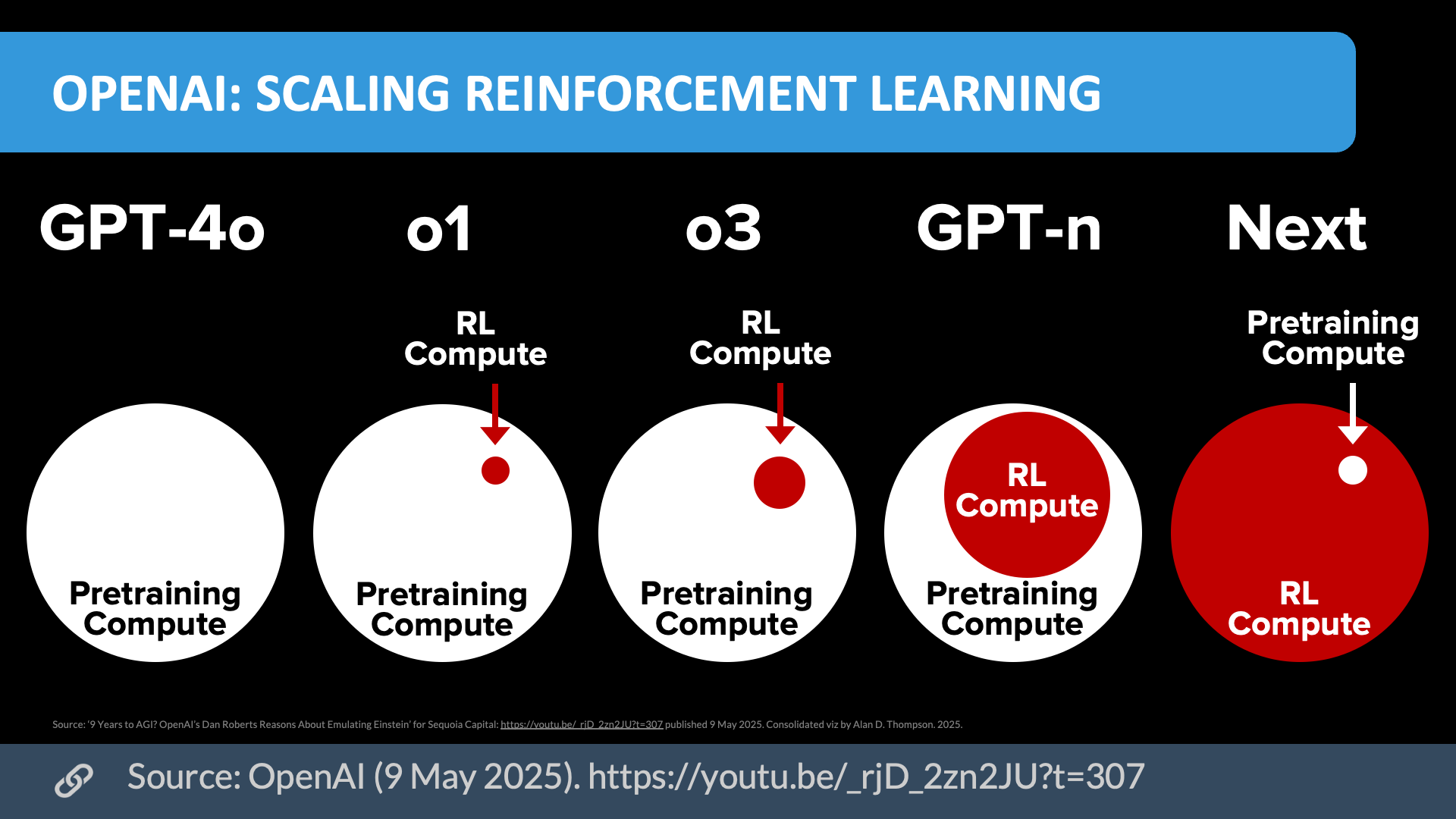
RL wasn't a waste—it needed the foundation model "cake" first (2024-2025)

Why RL Works Now (vs. 2019 criticism):

  • Foundation models provide common sense: LLMs solve the "cold start" problem
  • Verifiable environments: Code execution, math proofs enable RLVR

Modern Success Stories:

  • OpenAI o1: Extended thinking time via RL, 83% → 94% on AIME with more compute
  • DeepSeek R1: Open-source reasoning model matching o1 performance
  • Code generation: RL improves debugging, test-driven refinement
Part 4: Current State & Future Trends

Core Capabilities:

  • Conversational AI: Real-time voice interactions with reasoning (Gemini Live, GPT-4o Voice)
  • Multi-modal AI: Unified processing of text, images, audio, and video
  • Coding Agents: AI pair programmers with autonomous debugging (Cursor, Claude Code, Copilot)
  • Specialized AI Agents: Domain-specific assistants with tool use and memory
  • Hyper-Personalization: Tailored experiences

Transforming Industries:

  • SaaS: AI-first applications, generative UI, embedded copilots
  • Healthcare: Diagnostic assistance, drug discovery, personalized treatment plans
  • Workplace: Automated workflows, AI-powered productivity tools, "Service as Software"

AI Evolution Stages

Perception AI (2012 AlexNet) - MATURE

  • Speech Recognition, Object Detection, Medical Imaging
  • Status: Production-ready, widely deployed

Generative AI (2020s) - MAINSTREAM

  • Digital Marketing, Content Creation, Image/Video Generation
  • Status: Rapid adoption, improving quality

Agentic AI (Current) - EMERGING

  • Coding Assistant, Customer Service, Patient Care
  • Status: Early deployment, variable reliability, human oversight required

Physical AI (Next) - EARLY RESEARCH

  • Self-Driving Cars (L4/L5 in limited areas), General Robotics
  • Status: Experimental, safety testing, limited deployment

LLM-powered Autonomous Agent Systems

Systems Thinking: LLM models are like powerful engines; you need systems like airplanes, cars, or factories to take advantage of them and produce value.

Components:

  • Foundation model: Intelligence/reasoning engine
  • Tools: Calculator, code interpreter, web search, APIs
  • Planning: Chain-of-thought, self-reflection, subgoal decomposition
  • Memory: Short-term context + long-term storage
  • Action execution: Real-world task completion

Applications: Customer service, business optimization, code generation, research, personal assistants

Next Challenges

World Model:

  • Problem: Next-token prediction insufficient for 3D spatial reasoning, needs understanding of physics
  • Data gap: Scarcity of "boring" everyday activity data, limited 3D spatial data
  • Efforts: Tesla FSD (end-to-end vision), GAIA-1 (Wayve), Sora's physics understanding, Genie 3, World Labs

Persistent Memory:

  • Problem: Don't want AI "acting like it's their first day every day"
  • What to store: Importance, recency, relevance (forgetting curve)
  • How to store: Knowledge graphs, temporal sequences, hierarchical memory

Continuous Learning:

  • Need: Models with "muscle memory" and continuous learning
  • Challenge: Catastrophic forgetting vs. learning from mistakes
  • Analogy: "Sleeping over it" effect for consolidation

ML and DL Jagged Performance


source: HOGgles: Visualizing Object Detection Features, NDTV

Risks and Responsible Development

Demonstrated Capabilities and Risks:

  • Evolution: Sandboxed → read-only internet → agentic write capabilities

Current Risk Acceleration:

  • CONCERN: Agentic deployment without adequate guardrails
  • Vision-Language-Action (VLA) models: Extending AI to physical robots
  • HISTORICAL PARALLEL: Autonomous vehicles required extensive testing

Accessibility vs. Safety Trade-off:

  • RISK: Easy deployment without training expertise
  • RECOMMENDATION: Careful evaluation before factory and home deployment

source: LinkedIn Yondu AI

left:40%

Summary

  • Scale through efficiency, not just resources: Raw compute and data are expensive; algorithmic and architectural improvements achieve scale with same resources

    • Efficient models, smarter learning methods, better search algorithms, effective context management
    • Efficiency often the key enabler for scaling
  • Natural language as universal interface: LLMs are foundational technologies—comparable to fire and the internet—democratizing access to intelligence

    • AI Agents with tool use, memory, and planning are transforming everything
  • The intelligence trade-off: More capability and autonomy requires accepting less control and interpretability

    • We will learn to trust intelligent systems more
  • Next frontiers: World models, persistent memory, and continuous learning

    • Spatial reasoning, physics understanding, learning from experience without forgetting
  • Responsible deployment: Robust guardrails and evaluation frameworks needed before autonomous operation at scale

Thank You

Questions?

Jit Ray Chowdhury
Jan 2026

https://www.jitrc.com/age_of_gen_ai/

References

Additional Resources:

References: The Bitter Lesson

  1. The Bitter Lesson by Rich Sutton (PDF)
  2. Medium - The Bitter Lesson
  3. arXiv - The Bitter Lesson of Scaling
  4. Cognitive Medium - The Bitter Lesson
  5. Xander.ai - Robotics and The Bitter Lesson
  6. Exxact Corp - Revisiting Sutton's Bitter Lesson
  7. Hacker News Discussion 1
  8. Hacker News Discussion 2
  9. Reddit - The Bitter Lesson 2.0

References: Self-Supervised Learning & RL

Yann LeCun's Cake Analogy:

"Deep Reinforcement Learning is a waste of time" (2019):

RL Renaissance:

Appendix

A1: Challenges of Reinforcement Learning (RL)

Difficulty of Reward Specification:

  • Designing effective reward functions without incentivizing unintended behavior (reward hacking)
  • Hard to specify "good" outcomes precisely and comprehensively for complex tasks

Sample Inefficiency:

  • Requires vast number of environment interactions to learn optimal policies
  • Expensive, time-consuming, or dangerous in real-world applications (robotics, autonomous driving)

Limited State and Action Spaces:

  • Historically successful only in constrained environments (board games, simple control systems)
  • Real-world problems involve high-dimensional, continuous spaces making exploration extremely challenging

Need for Common Sense and Guided Exploration:

  • Early RL struggled without prior knowledge or domain-specific heuristics
  • Agents would "wander aimlessly" in vast, unstructured environments without guidance

A2: Unsupervised Learning: Images vs. Language

Challenges with Images:

  • Raw pixel data lacks explicit, discoverable hierarchical structures consistent across diverse images
  • Pixel meaning highly context-dependent (red pixel could be car, flower, or brick wall)
  • Unsupervised models often learned noisy or uninterpretable features without human-annotated labels

Success with Language:

  • Sequential and Contextual Nature: Words appear in specific order conveying meaning; context provides strong learning signals
  • Statistical Regularities: Rich patterns in word co-occurrence and grammatical structures
  • Hierarchical Structure: Natural progression from characters → words → phrases → sentences → paragraphs
  • Predictive Tasks: Masked language modeling (BERT) and next-token prediction (GPT) leverage inherent language structure

A3: AI Agents: Resurgence of Early Concepts

Early AI Limitations:

  • Complexity: Real-world environments overwhelmed available computational power
  • Uncertainty: Assumed perfect knowledge of environment (rarely realistic)
  • Brittleness: Rule-based systems failed when encountering unprogrammed situations
  • Lack of Common Sense: Missing broad, intuitive understanding of the world

LLMs Re-enabling Classical Methods:

  • Broad World Knowledge: Unprecedented breadth of general knowledge and common sense from vast training data
  • Natural Language Interface: Human-like text understanding enabling intuitive goal specification
  • Reasoning and Planning: Emergent capabilities for breaking down complex tasks into sub-goals
  • Tool Use: Can be augmented with external tools (APIs, search engines, code interpreters)
  • Handling Unstructured Information: Excel at processing real-world's dominant unstructured text format